


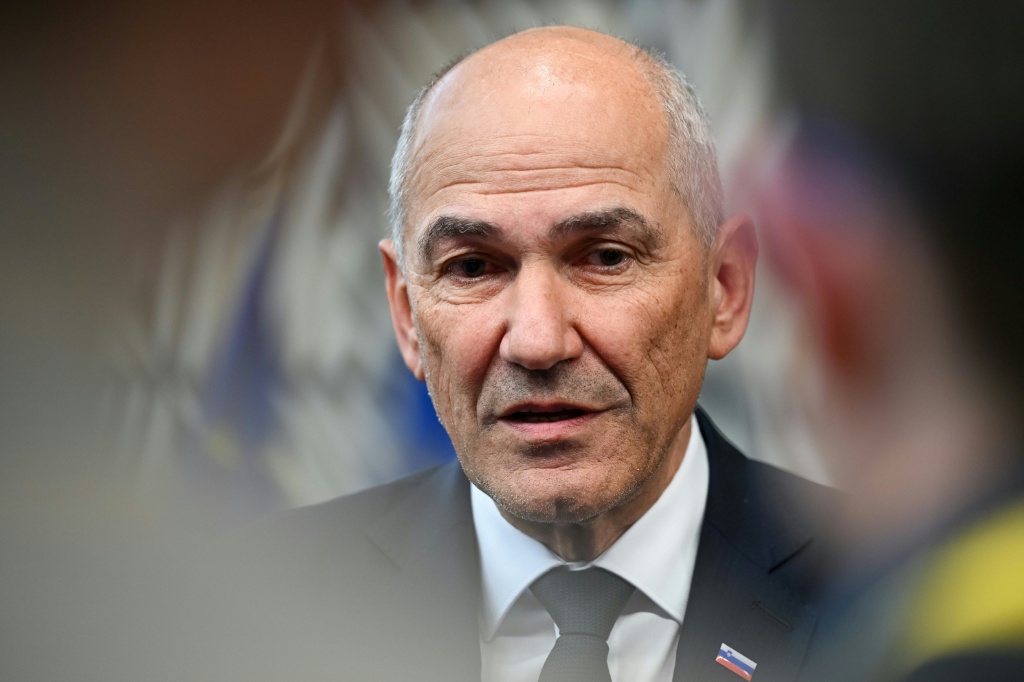
Four months after nationalist Prime Minister Janez Jansa took office in Slovenia, a series of referendum votes will test support for his reforms decried by the opposition as "authoritarian".
Jansa -- a political veteran and admirer of US President Donald Trump -- came to power after liberal ex-prime minister Robert Golob failed to form a government despite his party's narrow victory in March parliamentary elections.
Promising a "cheaper state but with better quality", Jansa has proposed cutting public-sector jobs and cutting funding for civil-rights NGOs, among moves that have drawn criticism from opponents.
Jansa has already served as Slovenia's prime minister three times, and he had frequent run-ins with the European Union during his last stint in power from 2020 to 2022 and saw a series of anti-government demonstrations.
Critics accused Jansa of attacking media freedom and the judiciary and undermining the rule of law.
Sunday's votes include a binding referendum on a law that would expand the powers of parliamentary inquiry commissions.
If voters do not reject that measure, those summoned to testify would be required to do so immediately and would not be able to challenge the summons until the commission has completed its work.
The opposition says those called to testify could be compelled to disclose sensitive information and described the law as setting up a "political police".
The government has also called three non-binding referendums on issues likely to resonate with its supporters.
One concerns the abolition of the mandatory monthly contribution that finances public television, leaving it to the government.
The others are on banning non-Slovenian residents from voting in local elections, and on linking support for long-term unemployed people to their working in voluntary public services.
A poll published by private broadcaster POP TV recently suggested most citizens support the government's moves. It showed 37 percent backing the expansion of the parliamentary inquiry powers and 29 percent against it.
Golob has warned that the two million people in the EU member country face "a real test of how resilient Slovenian democracy is".
"As the opposition, we will do everything we can to put all these tendencies toward an authoritarian system to the test before the public.... It will not be easy," Golob told AFP in an interview, citing voter "apathy".
For the referendum results to be valid, the winning vote has to be supported by at least 20 percent of eligible voters.
Analysts predict a low turn-out, which may hamper the validity of the result.
Political commentator Aljaz Bitenc Pengov said Jansa's reforms were "extremely conservative virtue signalling, similar to what we see in the policies of Trump's second term, and to the ideas pushed by (Britain's) Nigel Farage and (France's) Marine Le Pen".
"It's far-right politics devoid of imagination," Bitenc Pengov told AFP.
Jansa has also vowed to cut public sector jobs, aiming to shift tens of thousands workers from the public to the private sector rather than relying on foreign labour.
Soon after taking office, the government passed legislation lowering taxes and social contributions for high earners, liberalising parts of the healthcare system and allowing pensioners to resume work without losing their pensions.
Public sector unions have gathered 40,000 signatures needed to trigger a binding referendum, expected in November, on the government's proposed Intervention Law for Slovenia's Development.
The weekend referendums "are just the appetiser", with the bigger fight looming over that intervention law, Bitenc Pengov said.
Local elections will also be held in November in another test for the government.