


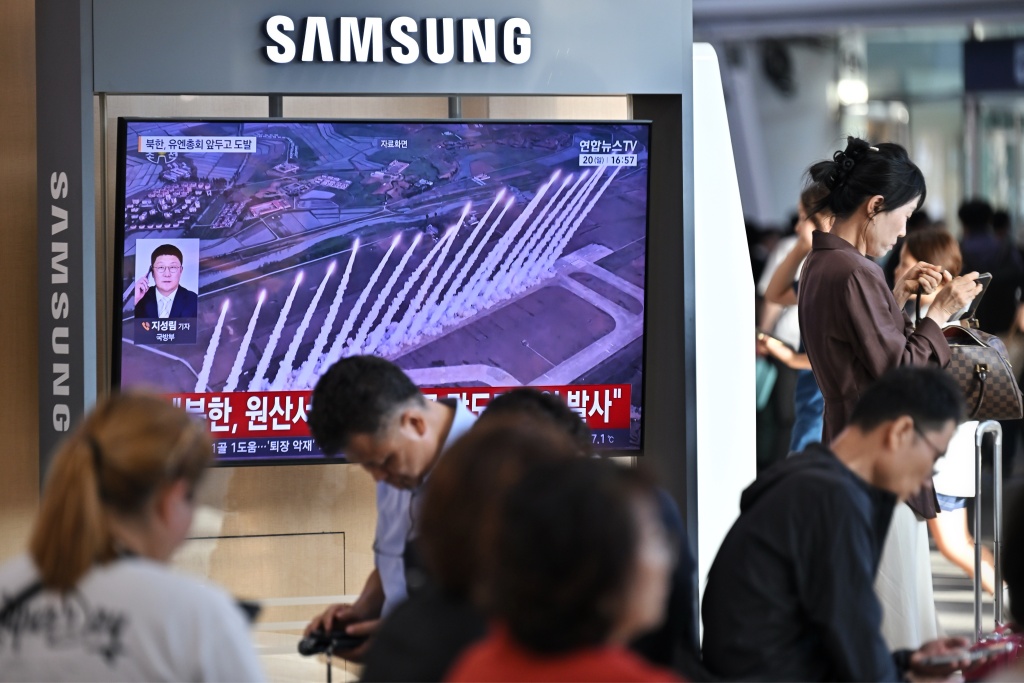
Pyongyang blasted on Monday the FBI's allegations it was behind the theft of $6 billion from cryptocurrency platform Binance, as it test-fired strategic cruise missiles in a new display of its weapons capabilities.
The missile launch came on the heels of a public rebuttal from Kim Yo Jong, the powerful sister of leader Kim Jong Un, who slammed the FBI's allegations as a "grave political provocation".
On Saturday, the FBI said a North Korea-affiliated hacking group called TraderTraitor had been behind the hack.
Experts see the incident as potentially the largest cryptocurrency theft in history, with a haul equalling "nearly a quarter of the DPRK's estimated annual GDP," Michael Bosack, founding director of the Parley Policy Institute and a former UN Command official, told AFP.
Kim Yo Jong said the FBI's claim was "absurd rhetoric and nothing new," given prior US allegations that Pyongyang was behind last year's major hack of Bybit.
Still, North Korea likely felt compelled to respond because of the "level of international attention on the incident", Bosack said.
The denial was aimed at maintaining channels through which North Korea could continue laundering and using the cryptocurrency, Bosack added.
"If external parties start closing doors based on the international heat on the matter, then the stolen cryptocurrency does nothing to support the Kim regime's near-term priorities," he said.
A 2024 United Nations report said proceeds from North Korean cyberattacks had "reportedly helped to fund the country's development of weapons of mass destruction".
The Monday launch involved strategic cruise missiles fitted with a new cluster-munition warhead, the official Korean Central News Agency reported Tuesday.
"The middle-sized dispersal warhead tipped on the cruise missile is capable of turning into ashes a target area of 5 to 6 hectares with its highest-density power," KCNA said.
KCNA said the test had "perfected the capability to deliver a vertical strike against the target by improving the terminal maneuverability of the cruise missile".
A North Korean official was quoted as saying the test was conducted "because our armed forces should defend the security of the country and deter all sorts of threats."
North Korea is demonstrating that they are capable of disabling "key South Korean and US military infrastructure, including airfield runways, radar bases, air defence batteries and assembled troops, with a single cruise missile", Lim Eul-chul, a professor at the Institute for Far Eastern Studies at Kyungnam University, told AFP.
The launch also aims to provide a "double deterrence against South Korea by strengthening conventional asymmetric strike capabilities at a stage before the use of nuclear weapons", he said.
The nuclear-armed North recently trialled a range of weaponry including attack drones, a new precision-guided torpedo system and an intermediate-range hypersonic missile.
South Korea's military did not announce the cruise missile launch, as it had also not done with Sunday's test.
Unlike ballistic missile launches, North Korean cruise missile tests are not prohibited by UN Security Council sanctions.
Asked Monday about Sunday's reported test, Joint Chiefs of Staff spokesperson Jang Do-young said South Korea and the United States were "closely coordinating and conducting a highly detailed analysis of its characteristics and specifications".
"Our military does not announce all projectiles launched by North Korea," Jang said, citing operational security and the protection of intelligence assets.