


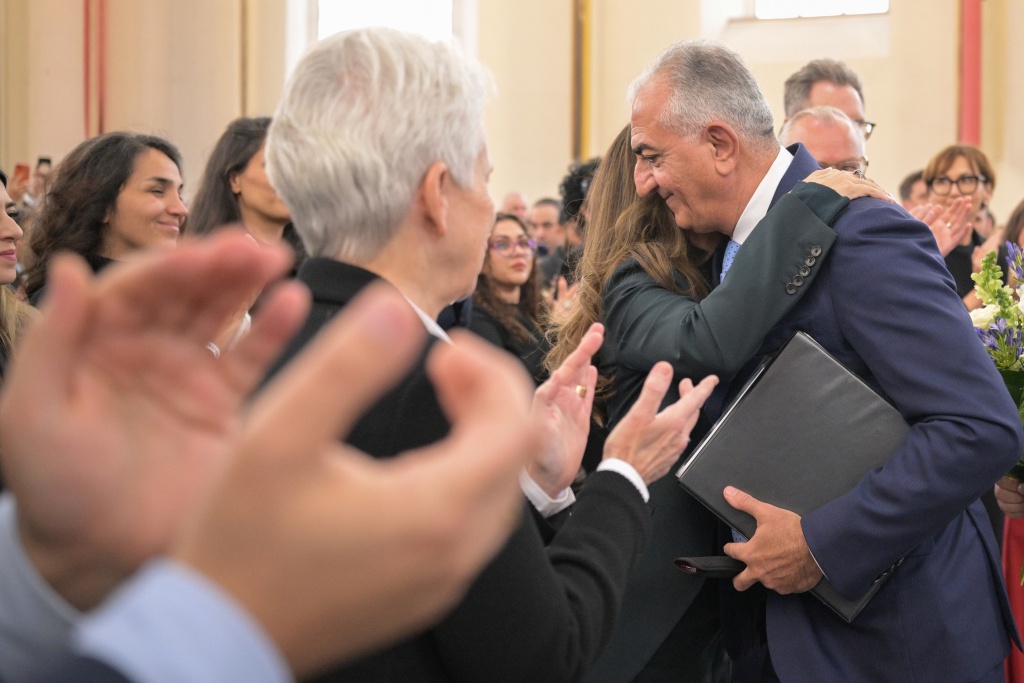
The son of the ousted shah of Iran on Saturday received a "Freedom Prize" in Frankfurt awarded to the Iranian people in a ceremony that critics said was illegitimate.
Some 18,000 demonstrators, many chanting support and waving pre-revolutionary Iranian flags, greeted Reza Pahlavi as he turned up in the German city to be handed the honour, according to a police estimate.
The prize was awarded by the Friedrich Naumann Foundation, an activist group close to Germany's liberal FDP party.
Iran "is a country not waiting to be taught democracy, this is a country being prevented from practising it", Pahlavi said at St Paul's Church, famous for hosting Germany's first-ever elected parliament in 1848-1849.
"A people ready to die for the right to vote is willing to exercise the right to vote," he added to applause.
Anti-government protests broke out at the end of last year in Iran and were suppressed in a January crackdown by security forces which rights groups say killed tens of thousands.
Pahlavi's voice quivered as he spoke of the relatives of those killed, some of whom were present in the hall.
"You could not have chosen a people who better understand the meaning of the word 'freedom'," he told the foundation.
Pahlavi taking receipt of the prize was not welcomed by all, despite the visible support he enjoyed on the streets of Frankfurt.
Pahlavi's father, Mohammed Reza Pahlavi, was the last shah of Iran, an autocratic ruler who fled into exile in 1979 ahead of a broad revolution that overthrew the monarchy and later became consolidated under Islamist clerical rule.
Others criticise Pahlavi for his vocal support for Israel and accuse him of failing to distance himself sufficiently from his father's autocratic rule.
About 200 prisoners held in Iran signed a letter protesting Pahlavi's receipt of the prize, according to Sahar Sanaie, spokeswoman for the Society for German-Iranians in the state of Hesse, considering him a symbol of a "bygone dictatorship".
The Frankfurt branches of the centre-left SPD and Greens boycotted the event, arguing Pahlavi could not be considered a legitimate representative of the Iranian people.
The Frankfurt branch of the far-left Die Linke said the church should not host the event, pointing to city statutes that prevent the place of worship from hosting political events.
Speaking Saturday, Pahlavi said he was accepting the prize only as a "trustee" until a democratically-elected government was in power in Iran.
"I hold it only temporarily," he said. "One day I will place it in the hands of its rightful owners, not on foreign soil but in the capital, Tehran."