


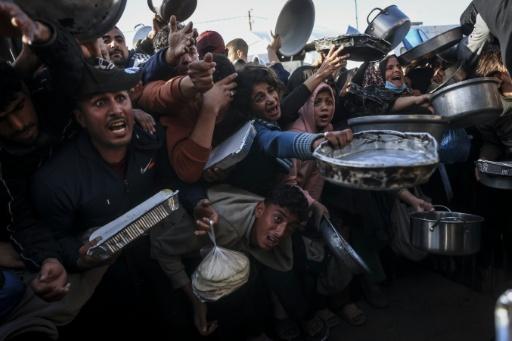
Gaza is suffering the world's worst economic crisis ever recorded, with nine in 10 businesses destroyed and hundreds of thousands of people unemployed, a top UN development agency warned on Thursday.
Israel's military offensive sparked by Hamas militants' attack in October 2023 devastated the territory of two million people before a patchy ceasefire was announced in October 2025.
"The collapse of the economy of Gaza is the world's most severe economic crisis on record," said Pedro Manuel Moreno, acting secretary-general of the UN Conference on Trade and Development (UNCTAD).
"It has wiped out decades of development and generated an acute economic crisis for its people," he told reporters in Geneva as the organisation released a new report.
It said 92 percent of Gaza's "economic establishments have been damaged or destroyed".
The territory's daily per capita GDP is $0.58 a day, the report said. Prices are 274 percent higher than in 2022.
Israel's military offensive killed more than 73,000 people, according to the territory's health ministry under Hamas authority, whose figures are regarded as reliable by the United Nations.
It displaced virtually the entire population and damaged or destroyed most of its buildings.
Before October 2023, "two out of three Gazans were poor. Today, everyone in Gaza is multidimensionally poor," said Mutasim Elagraa, UNCTAD's coordinator for assistance to the Palestinians.
Industrial activity and agricultural production have fallen by 94 percent, with only 1.5 percent of arable land accessible, forcing "total dependence on humanitarian food aid", Elagraa said.
According to the report, the conflict has destroyed hundreds of thousands of jobs, leaving more than 90 percent of Gaza's working-age population unemployed.
The report also detailed an economic and financial crisis in the occupied West Bank, citing "reduced access to land and natural resources linked to (Israeli) settlement expansion".
The Palestinian government has borrowed heavily from local banks, drawn on the Palestinian pension fund and owes money to private contractors, Elagraa said.
The Palestinian territories risk a "banking collapse", he warned. The "political and social and humanitarian consequences will be immense".