
Qorium Becomes Reyva as Cultivated Leather Company Moves Towards Commercial Scale
02 Nov. 2026 - 11:00
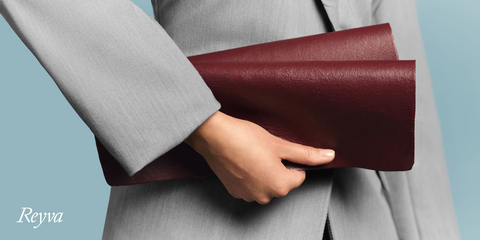
New identity signals the company’s evolution into a standalone material brand for luxury and automotive markets
- Reyva develops real leather by cultivating bovine collagen from a small sample of animal cells.
- The new brand brings together advanced biotechnology, leather expertise and a clearer luxury proposition.
- The company’s team, technology, partnerships and commercial ambition continue under the new name.
Qorium, the company that develops cultivated real leather, today announces that it is becoming Reyva. The new name and identity mark its next stage: moving from a pioneering technology business towards a global material brand built for the exacting standards of the luxury leather sector.
This press release features multimedia. View the full release here: https://www.businesswire.com/news/home/20261102661351/en/
Reyva creates beautiful, high-performing real leather. By cultivating leather in uniform sheets, we can move beyond the natural limits of traditional hides, with greater control over its shape, size, thickness and structure. Reyva sample photography by Laurent Stevens
Reyva grows collagen directly from animal cells and cultivates it through a proprietary process to create uniform sheets. The resulting material is then tanned to become real leather, made from the same natural material that gives conventional leather its strength, breathability and durability. It does so without the necessity of raising or slaughtering animals, and with dramatically reduced waste, water and energy demands compared with traditional leather production. Reyva’s process is designed to give brands greater control over thickness, structure, quality and traceability, while eliminating the variability and waste associated with animal hides.
The relaunch gives the company a more distinctive platform for commercial growth while preserving what sits at its core: advanced tissue engineering, deep leather knowledge and a commitment to creating a premium material that can work with established tanning, finishing and manufacturing processes.
The name Reyva brings together “RE,” inspired by reinventing leather, and “VA,” expressing forward movement. It also echoes rey , the Spanish word for “king,” offering a subtle nod to luxury. Reyva is pronounced RAY-vuh, with the emphasis on the first syllable “ray,” as in a ray of light.
“Reyva reflects the company we have become: ambitious, design-led and ready to stand alongside the world’s leading material brands,” said Michael Newton, CEO of Reyva. “Our science gives us a fundamentally new way to make real leather. Our next chapter is about turning that capability into a material that designers and manufacturers choose for its beauty, consistency and performance, as well as its sustainability credentials.”
Reyva’s platform begins with a small, painless biopsy. Selected cells are banked and multiplied before being cultivated in proprietary tissue bioreactors, where they form collagen sheets. These sheets are then tanned and finished using leather-industry craftsmanship and expertise. The material can be cut, stitched, embossed, tanned and finished, and can be engineered to meet the requirements of different applications.
The company is industrialising its process at the Brightlands Maastricht Health Campus in the Netherlands. It is working with selected partners in automotive and luxury fashion as it progresses from development to commercial volumes. Initial availability will be limited, with capacity increasing as the company scales.
“Leather is an extraordinary natural material, but its conventional production begins with the limits and variability of an animal hide,” said Dr Mark Post, co-founder and Chief Science Officer of Reyva. “By cultivating collagen in a controlled environment, we can preserve the qualities people value in leather while introducing a new level of precision, consistency and resource efficiency.”
An independent life-cycle assessment by CE Delft projects that Reyva’s cultivated leather could achieve an 87% lower carbon footprint than conventional cow-derived leather at full-scale production in 2029 using renewable electricity. The assessment calculated 10.5 kg CO₂-equivalent per square metre at the tannery gate, including finishing, compared with a benchmark of 77–83 kg CO₂-equivalent per square metre for conventional French calf leather. Reyva will continue to update its assessment as the process scales and primary data becomes available.
Reyva was founded by tissue-engineering pioneer Dr Mark Post, leather-industry expert Rutger Ploem who comes from a family of tanners spanning six generations, and sustainability entrepreneur Stef Kranendijk. The company is led by CEO Michael Newton and has raised €30 million to date, including a €22 million Series A announced in November 2025.
View source version on businesswire.com: https://www.businesswire.com/news/home/20261102661351/en/
sarah@stbailey.com / +447402320448
© 2026 Business Wire, Inc.
Copyright Business Wire 2026
Disclaimer:
This press release is not a document produced by AFP. AFP shall not bear responsibility for its content. In case you have any questions about this press release, please refer to the contact person/entity mentioned in the text of the press release.