


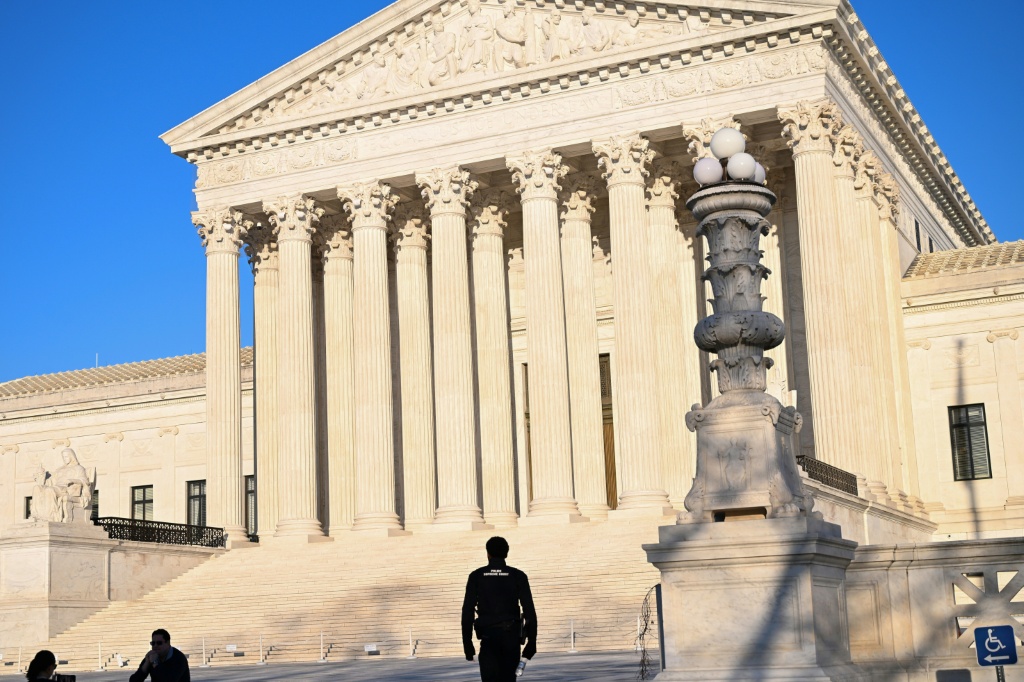
Conservatives who dominate the US Supreme Court appeared Tuesday to support a challenge by two Catholic preschools to a state requirement that they enroll children of gay or transgender parents in order to receive public funds.
The court, with six conservative judges to three liberals, has in recent years backed expanding the presence of religion in public life in America and has been keen to protect religious freedom, particularly in schools.
This current case involves Colorado, which provides state funding for tuition at public or private preschools, including faith-based institutions.
But Colorado has withheld money from the Catholic preschools involved in this case for violating anti-discrimination laws because they bar children of gay or transgender parents.
In a filing with the Supreme Court prior to Tuesday's hearing, Colorado said participants in the preschool funding program must enroll children regardless of the race, religion, sexual orientation or gender identity of the child or their parents.
The Catholic Archdiocese of Denver, two Catholic parishes and two parents, Dan and Lisa Sheley, filed a lawsuit seeking a religious exemption. But they lost in lower courts, prompting the appeal to the nation's highest court.
President Donald Trump's administration has backed the Catholic plaintiffs, who cite the First Amendment to the US Constitution guaranteeing freedom of religion.
Colorado welcomes religious preschools to the funding program, Helen Norton, the state's deputy solicitor general, told the court.
"The only thing Colorado asks is that they comply with the same conditions that every publicly funded preschool must meet, religious and secular alike," Norton said.
But conservative justices seemed to challenge the state, saying Colorado failed to acknowledge that its non-discrimination requirements and some religious beliefs could be incompatible.
Judge Amy Coney Barrett asked Norton to explain, for instance, the difference between explicitly excluding religious schools from funding and "choosing to impose a condition that you know that those schools will be unable to agree to."
One of court's liberal judges, Elena Kagan, said the plaintiffs were seeking not equal rights but rather preferential treatment.
"They need to be treated differently from other people -- because of their religious faith, to have a special accommodation," Kagan said.
Nicholas Reaves, a lawyer the Catholic plaintiffs, argued that "if someone is different, differently situated because of their religion," the way to remain neutral is to grant them an accommodation.
The Supreme Court, which includes three justices nominated by Trump, has sided with religious-right claims in a number of high-profile cases, several of which have involved Colorado.
In 2018, the court ruled in favor of a Colorado baker who declined to make a wedding cake for a same-sex couple, and more recently the court backed a Christian therapist who challenged a Colorado law banning "conversion therapy" for LGBTQ minors.
The Supreme Court is expected to issue a ruling in the preschools case by June 2027.