


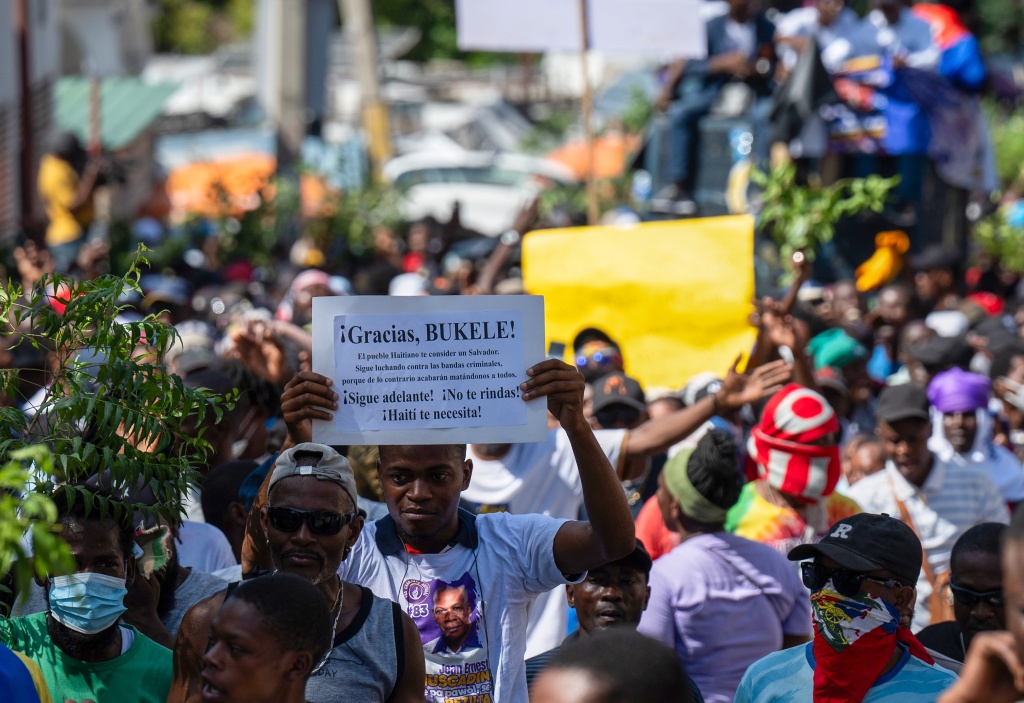
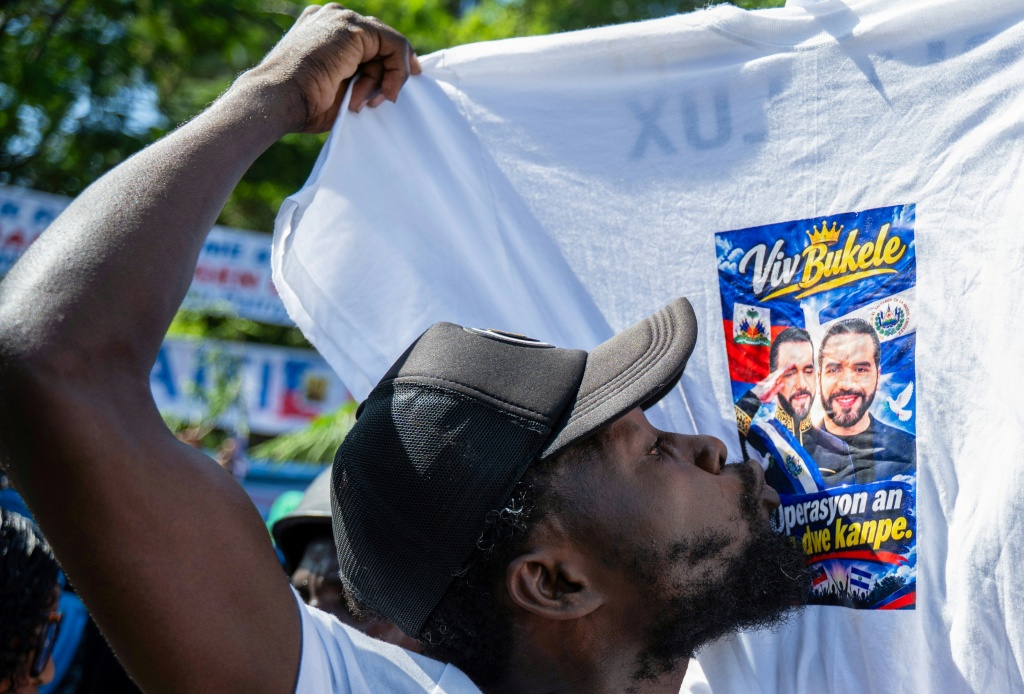
Thousands of Haitians took to the streets of Port-au-Prince on Tuesday to show their support for soldiers from El Salvador, sent by President Nayib Bukele to confront armed gangs that control large sections of the capital.
Signs carried by the demonstrators read "Thank you, Bukele," and "Long live Bukele," according to photographs taken by an AFP journalist.
Bukele has sent more than 2,000 troops into Haiti since late October, after four soldiers from his country went missing during an operation of the UN-backed Gang Suppression Force (GSF).
The new Salvadoran deployment, despite being separate from the GSF, has been welcomed by Haitian authorities, who have long sought more reinforcements to combat gangs.
Numerous armed forces are now operating in Haiti, with uncertain levels of coordination, including the Haitian police and army, the multinational GSF, foreign mercenaries and most recently, Salvadoran soldiers.
Bukele, whose forceful gang crackdown at home has won public support but sparked accusations of rights violations, appears prepared for more than just finding the four lost soldiers.
On November 10, he boasted of having destroyed the "headquarters" of one of Haiti's main gangs, accompanied by video footage of the helicopter attack.
Since then, Bukele's forces have taken over a football stadium in the capital with the support of Haiti's national police.
On Tuesday, the Office of the UN High Commissioner for Human Rights called on all security forces on the island to prioritize the protection of the population and resort to lethal force only as a last resort.
In the first 10 months of 2026, the UN recorded 4,595 deaths and 2,050 injuries to armed violence in Haiti.
Over the weekend, a soccer match in Miami pitted Haitians against the United States, and some Haitian fans cheered on both their national team and Bukele, expressing high hopes the island's gangs can be contained.
Despite the 6-0 loss to the US in the Concacaf Nations League match, Haitians expressed optimism, waving Salvadoran flags and shouting "Bukele! Bukele!" on game day.
"All I can say is 'Viva Bukele!'," said 41-year-old Haitian fan Guito Ledix, adding that Bukele "is the only one trying to see if there's any possibility of getting rid of the gangs."
Haiti, the poorest country in the Americas, has faced a deep political and security crisis for years, with gangs seizing control of the island nation through a campaign of violence marked by murder, kidnapping and rape.
From Miami, home to one of the largest concentrations of Haitian expats, 28-year-old Stephanie Jeanty frets about the safety of her family still living there.
"Before I was a bit more stressed, but now, seeing the Salvadoran delegation that is working to restore peace -- it's something, things are better," she said.
"I would really like to go back to my country. For now, no."