


After recent sharp drops for some Chinese tech stocks, Beijing is trying to prop them up -- seeing the sector, and in particular AI, as a central strategic priority.
In August, buzzy Chinese startup Unitree, whose walking, dancing humanoids are often used by AI researchers trying to make robots act autonomously, went public.
Its shares skyrocketed on its Shanghai debut in August -- but almost three months later they are down 40 percent from their peak that day.
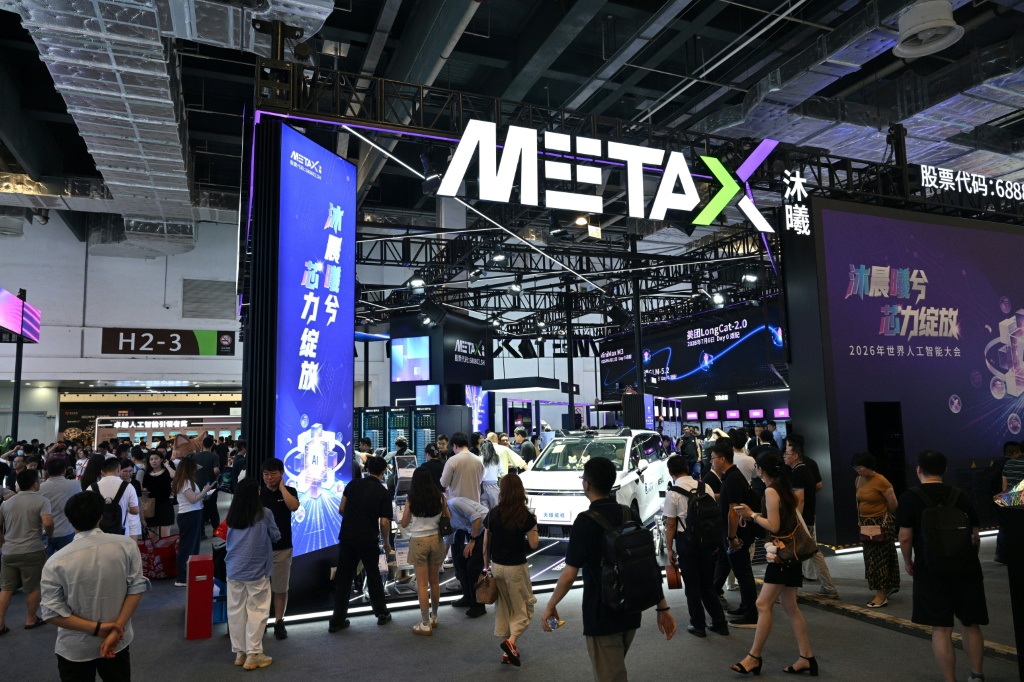
Chinese chipmakers Moore Threads and MetaX -- touted as challengers to US behemoth Nvidia -- have both plunged by around 50 percent over the past six months.
Similar steep falls can be seen across Shanghai's tech-focused Star50 index, China's answer to Wall Street's Nasdaq, which is down only around six percent over the same period.
Volatility on Wall Street hasn't helped -- the Nasdaq plunged 5.5 percent on Thursday -- with fears that the vast sums spent on AI infrastructure will not translate into big profits.
However, the Chinese government is taking steps.
Officials this week reactivated liquidity-injection tools aimed at encouraging share purchases while boosting the trading volume of state-backed investment funds, according to local media reports.
On Tuesday, net capital inflows into nine exchange-traded funds (ETFs), commonly used by Beijing to prop up the market, reached 120 billion yuan ($18 billion) -- a near-record, according to Bloomberg data, targeting tech stocks in particular.
The Financial Times also reported this week that Chinese regulators had told banks to halt company listings in an attempt to boost market liquidity.
"Chinese technology shares have been under significant pressure, with investors concerned about weak domestic demand, intense competition and disappointing earnings," said Charu Chanana, chief investment strategist at Saxo Markets.
However, now "fresh policy support, lower valuations and hopes of improving sentiment are encouraging investors to revisit a sector that has struggled for much of the year", she added.
Overall, tech investors in China remain optimistic, said Ajin Jin, partner at Shanghai-based investment firm Kunquan.
"In both Beijing and Shanghai, weekly roadshows are still taking place, and every single one is packed to the rafters, with people even sitting in the aisles," he said.
Li Daxiao, one of China's most prominent investment gurus, also said "the burgeoning development of the industry is unstoppable" and should be clearly distinguished from "share price fluctuations".
"Technology shares have been affected by external risks and have fallen in tandem with their counterparts in the US, Japan and South Korea," he told AFP.
Stephen Inness of SPI Asset Management said that "a state-backed effort would add to steps taken by China last month to stabilise its equity market".
However, he warned the measures "have so far proved insufficient against the backdrop of a weak domestic economy and doubts over AI earnings".
Latest stories

Sports Olympic refugee athletes target glory -- and a better life for families
Lourence Numukiza, a 16-year-old athlete from DR Congo, has gone from being a war refugee to earning a prized berth at the...

Business and Economy Paraguay Senate rejects bid to delay president impeachment trial
Paraguay's Senate on Friday rejected President Santiago Pena's bid to delay his impeachment trial over a banking scandal that has seen millions of people temporarily...

Climate and Environment Turkey eyes energy self-sufficiency by 2040 but no coal exit yet
Poised to host the COP31 climate summit, Turkey on Friday unveiled an ambitious $500 billion roadmap for electrifying its economy and slashing imports, but offered...