


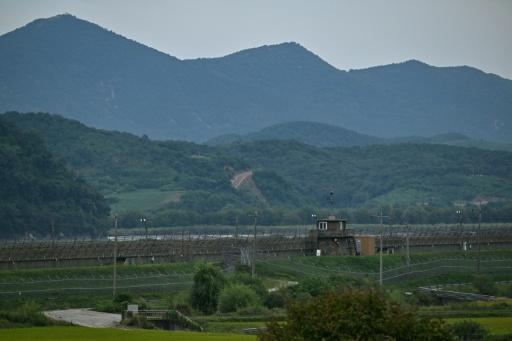
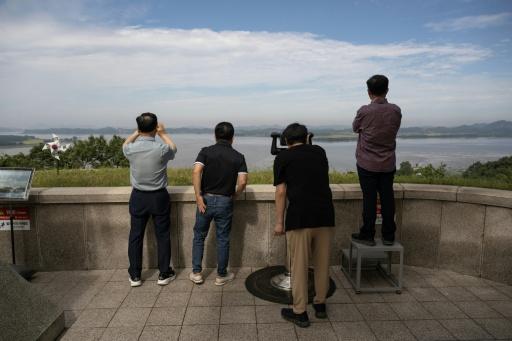
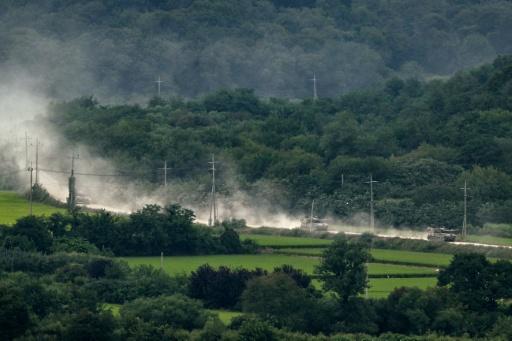
A building-sized North Korean flag waves from a tower on the de facto border with South Korea, marking territory that experts say has become nearly impossible to escape.
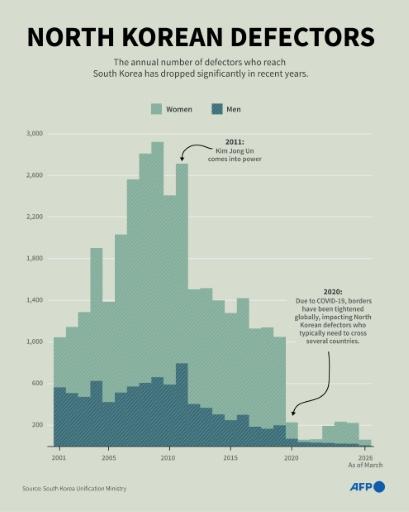
The combined total of North Koreans to reach South Korea in the past six years is less than the number that typically defected each year for decades -- and appears to be declining further in 2026.
The main cause is leader Kim Jong Un's aim to preserve his family dynasty by sealing the country off from the outside, keeping people in and information out, experts say.
"As I understand it, bringing family members directly from North Korea is currently impossible," 29-year-old Chae Yoon-seo, who fled in 2019, told AFP.
She swam across a river into China at night with a smuggler's help, and travelled through Laos, Vietnam and Thailand before finally flying to South Korea.
Defections to the South hit a peak of more than 2,900 in 2009 and stayed well above 1,000 per year for the next decade.
But there were just 63 in the first half of this year -- down by over a third from the same period in 2025, said Seoul's Unification Ministry.
Arrivals have fluctuated over the decades, but plunged sharply during the Covid pandemic when many nations shut their borders.
A key change in North Korea, however, started years before.
After taking power in 2011, Kim began restricting the informal trade and migration links along the roughly 1,415-kilometre (880-mile) northern border with China.
In addition to being an economic lifeline, the Chinese border region has also been the first step in most defectors' escapes.
The long frontier was relatively porous, unlike the heavily mined, fenced and surveilled Demilitarized Zone (DMZ) that serves as the Koreas' de facto border.
Along the boundary with China, Kim's government has erected fences and installed cameras as well as strips of sand that preserve the footprints of anyone who crosses.
"North Koreans built a real Soviet-style border security system," said Andrei Lankov, an expert on the North at Kookmin University in Seoul.
Beijing has helped too, said Lankov, noting China's preference to keep the status quo of the Kim dynasty by opposing potential instability from defectors or their supporters.
As part of its efforts, China reportedly has put in place hundreds of facial recognition cameras, noted Rachel Minyoung Lee, senior fellow with the Stimson Center's 38 North.
She added that Beijing also added more patrol boats and new or planned deportation facilities along its northeastern border.
The roughly 34,500 defectors to reach the South since 1998 are a fraction of North Korea's 26.6 million people, UN figures show, but the plunging number of escapes has consequences.
"Defectors are the main source of information about the North," said Fyodor Tertitsky, lecturer at Seoul's Korea University, noting both South Korean intelligence and researchers interrogate them.
Though some people still do get out.
Defector Gyuri Kang's 2023 escape by boat with her mother and aunt -- across the maritime border with the South, an extremely rare feat -- was a "miracle", she told a UN hearing.
She is also a case in point for why North Korea has made great efforts to seal itself off.
Kang noted the influence of South Korean dramas smuggled in on USB drives, finding them "so refreshing and more credible than North Korea state propaganda".
"North Korean authorities are keenly aware of the impact of outside media," she said.
In 2020, North Korea made possessing foreign media a crime punishable by years-long forced labour terms –- and potential death sentences for large-scale distribution, according to Amnesty International.
Lankov, from Kookmin University, said external information is the greatest threat to the long-term survival of North Korea's leadership.
"If they let their people interact with the outside world, they are highly likely to be overthrown, and maybe killed or driven into exile," he added.
Chae, the defector, said her hope was that the North's isolated people are not one day simply forgotten by the outside world.
"These days, there are a lot of cynical reactions on helping other countries, so I am a bit worried that one day, interest in North Korean human rights might fade away as well," she added.
Latest stories
Society Why India's opposition wants top poll official out
The Election Commission of India, long regarded as the guardian of the world's largest democracy, is facing scrutiny after a newspaper investigation alleged impropriety...

Sports India, Pakistan on Asian Games collision course after cricket washout
India and Pakistan stayed on course to meet in the Asian Games cricket final after both men's quarter-finals were abandoned Monday because of rain and...

Climate and Environment Nothing to seal here: NZ police help stranded pup home
New Zealand police came to the rescue of a seal crossing a busy road, helping the perplexed pinniped pup back safely into...